The Surveillance Pricing Study: Why Two Shoppers May See Different Prices
SURVEILLANCE PRICING - E-COMMERCE - SHOPPING PSYCHOLOGY
Published On: May 18, 2026
Picture this for a second.
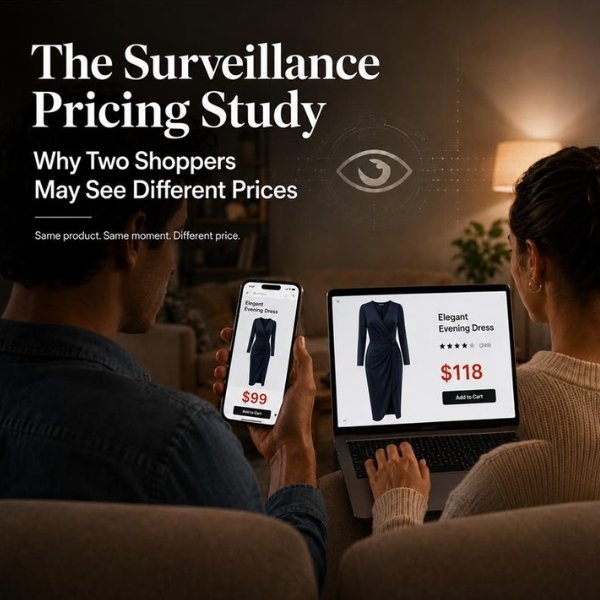
Two friends are sitting side by side on the same couch, searching for the same dress on the same retail website. One is browsing casually on a newer iPhone after work. The other is using an older laptop while comparing reviews in multiple tabs.
Same city. Same product. Same moment.
But when they glance at each other’s screens, the prices are different.
One sees $99.
The other sees $118.
This isn't a glitch, a temporary caching error, or a regional mistake. It is the reality of modern retail.
We are moving past the days of the old, static price tag. Today, a growing number of online marketplaces are testing a strategy known as "Surveillance Pricing" or “Dynamic Pricing”. Instead of just pricing an item based on what it costs to make, advanced computer programs can now price you. By analyzing real-time data clues, like your device type, your approximate location, your battery life, or your immediate browsing history, retailers can frequently predict your urgency and estimate your willingness to pay at that exact second.
Our goal here isn't to demonize this technology. For a business, changing prices quickly helps it manage its stock and run smoothly. But as a shopping transparency project, we wanted to know the real truth: Is this actually happening everywhere, or is it just a few rare cases? To find out, the ClothingRIC Team did the heavy lifting so you don't have to. We carefully reviewed a wide range of the latest global research papers, economic data studies, and government tech reports to connect all the dots and lay out the facts. What we found completely changes the way you look at a "buy" button forever. We’re breaking down the data to hand you the ultimate cheat code, so you can outsmart the store's algorithm and take control of your checkout screen.
What the Global Research Data Actually Shows
When we started digging into the official academic and economic studies, we realized that this personalized pricing is happening on a much bigger scale than the average shopper thinks. We focused our investigation on five major studies that look at how AI, your personal data, and online stores mix. What we found from these studies is a total eye-opener.
The "Invisible Haggle" (How Stores Guess Your Highest Price)
According to an economic report highlighted by PBS NewsHour, online shopping has secretly gone back to a very old way of buying things: the market negotiation. For a long time, stores used "fixed pricing", meaning one public price for every single person. If you wanted a different price, you had to physically go to a market or a car lot and haggle back and forth with a salesperson.
The PBS data shows that AI has successfully taken that haggling process and automated it, but with a sneaky twist. Economists call this First-Degree Price Discrimination. The algorithm acts like an incredibly fast, silent negotiator for the store. It looks at your digital profile, guesses the absolute highest amount of money it can squeeze out of you without making you close the tab, and prints that exact customized number on your screen before you even click "Add to Cart.
It’s Not Just for Flights Anymore
A lot of people think that fast-changing prices only happen when buying airline tickets, booking a hotel, or ordering an Uber during a busy rush hour. However, our review of the tracking data published on ResearchGate proves that this technology has moved into almost every type of online store.
The data tracks how pricing software is now built directly into websites that sell consumer electronics, kitchen appliances, and even your weekly groceries. The standard, reliable price tag is officially dead. Because these software programs are plugged right into standard shopping sites, the price of a laptop, a kitchen blender, or an online grocery order can change just as fast as a flight across the country."
The Psychology of Fairness and the "Trust Collapse"
One of the most interesting parts of our research was looking at how this affects our minds and how we feel about shopping. A major behavioral study published in ScienceDirect measured how shoppers felt the exact moment they realized an online price was personalized just for them.
The data showed a massive "Trust Collapse" among the people in the study. When someone finds out they are being charged more just because of their internet history, they don’t think it's a smart business trick; they feel like the basic rule of fairness has been broken. This bad feeling leads to something researchers call "Algorithm Aversion". It means shoppers don't just look for a better coupon; they completely give up on the store and leave. They walk away from brands they feel are "creepy" or sneaky, and look for stores that promise one honest price for everyone.
The Secret Science of Click-Tracking

How does the store's software actually know when to change your price? Tech reports and e-commerce patents map out exactly how these modern pricing engines watch you in real-time. The software doesn't just look at basic things like how old your account is; it actively tracks your physical movements on the page.
The research shows that these pricing tools are measuring:
- Your scroll speed: The exact speed at which you scroll down a product page.
- Your cursor pauses: The exact number of seconds your mouse hovers over a "Buy" or checkout button.
- Your page refreshes: How many times do you reload the same item?
- Your other tabs: Whether your browser settings show you were just looking at a competitor's website.
Think about it this way: If you scroll very slowly, read the return policy three times, and refresh the page, the algorithm assumes you are in a huge rush or highly stressed (like a parent looking for a specific baby formula, or a professional replacing a broken work tool). The data shows that the algorithm can take this hidden clue and use it to hold back discounts or give you a higher, personalized price.
The Non-Stop Live Price "Test"
Finally, a massive corporate pricing report published by Emerald Insight reveals that online shopping has turned into one giant, non-stop science experiment. The paper explains that modern stores use three main steps: updating prices fast, dividing users into groups, and running Continuous Price Experimentation.
This means that a weird price on your screen isn't always about who you are. Sometimes, the store's AI is just running a live test. The algorithm will randomly give a 4% higher price to a group of 10,000 shoppers just to see if they will notice and walk away, or if they will click "buy" anyway. The AI works like a super-smart corporate assistant, reading thousands of pieces of local data to constantly test how much money people are willing to spend before they complain.
Breaking the ‘Loyalty Trap’
One of the most ironic and frustrating things we uncovered while putting this research together is what we are calling the "Loyalty Trap". For decades, we’ve been told that building a relationship with a brand is the best way to save money. You sign up for the newsletter, download the store app, join the rewards program, and stay logged into your profile.
But our analysis of behavioral tracking software reveals something shocking: in an AI-driven world, being a "regular" can backfire completely.
Pricing algorithms are specifically trained to group shoppers by how likely they are to leave or stay. The software looks for what it calls "Safe Shoppers", people with low "churn risk" (meaning they rarely switch brands).
If the store's algorithm looks at your account and sees that you buy the same brand of running shoes from them every six months like clockwork, it realizes you love their store. Because the machine predicts you are highly unlikely to check other websites, it intentionally hides the massive "new customer" coupon codes from your account. Instead, it saves those big discounts for unpredictable, window-shopping users who are about to leave for a competitor. In short, your loyalty is being used as data evidence that you are willing to pay full price.
On top of that, these algorithms use your shopping history to mess with your head using fake urgency. We have all seen checkout screens that scream "Only 2 items left at this price!" next to a flashing red countdown clock. Our research into these systems shows that these warnings are very often made up just for you.
The AI looks at how fast you usually buy things. If your history proves that you are a high-intent shopper who panics and buys items quickly when confronted with an expiring deal, the system can dynamically trigger a fake timer or an artificial stock alert only on your screen. It creates a high-pressure environment designed to stop you from thinking clearly before you can look for a promo code or check a competitor's app.
This intense consumer profiling has gotten so aggressive that the federal government has stepped in to police it.
Federal Oversight Notice
- The House Energy and Commerce Committee Inquiry : In a massive escalation, federal lawmakers launched a sweeping investigation targeting 25 major corporate entities. They are demanding total disclosure from these companies to see exactly how their data-harvesting setups control real-time pricing at checkout.
- The FTC Investigation : At the same time, the Federal Trade Commission has expanded its investigation into the tech companies that build these pricing tools. The agency is looking directly at how "user segmentation solutions" are deployed to quietly exploit human behavior and penalize people just for being loyal customers.
Your 5-Step "Beat the Bot" Checklist
Now that we know how these store algorithms work, the trick is simple: if you hide your data, the computer can’t target you.
To be clear, there are plenty of complicated, tech-heavy ways to hide your tracks online. But you don’t need to be a computer genius to save a few bucks.
Instead of overwhelming you with a massive list, we want to share our personal tested. While there are many strategies out there, we are sticking strictly to the ones we have actually tested and proven to work. Based on our own trials, here is your quick, human-friendly playbook to beat the store's algorithm and get the lowest price.
Step 1: Go Ghost
Never do your initial product research while logged into your store account. Before you look up an item, open a clean incognito window, clear your browser history, or use a completely separate browser profile. This forces the website to treat you like a total stranger. It will show you the clean, normal public price before it can look at your history and hike the price up.
Step 2: Try the 24-Hour Cart Staredown
Once you are ready to buy, log in, put the item in your shopping cart, and then completely close the website tab. Walk away. Algorithms are terrified of "abandoned carts" because they think they are about to lose a sale. Very often, the store’s automated system will get nervous and email you a special "come back" coupon code within 12 to 24 hours just to close the deal.
Step 3: Swap Your Devices
If you are looking at an item on an expensive smartphone, take 30 seconds to check the same page on a laptop or desktop computer. Algorithms often assume that people shopping on their phones are out and about, in a rush, and ready to buy immediately. The software exploits this by adding a sneaky mobile markup. Checking different devices ensures you aren't paying a phone tax.
Step 4: Look for Secret Labels
Thanks to New York’s Algorithmic Pricing Disclosure Act, online stores that track your behavior must clearly state: "THIS PRICE WAS SET BY AN ALGORITHM USING YOUR PERSONAL DATA." If you see this text, the store is tailoring the price specifically to you based on your history or device. You can easily fight back and look for a lower price by clearing your browser cookies, using an Incognito window, or switching from your phone to a laptop.

Step 5: Never Blindly Trust "Member-Only" Deals (Why Public Coupons are Your Secret Shield)
Just because a pop-up claims an item is an "Exclusive Loyalty Discount Just For You" doesn't mean it’s a good deal. Algorithms frequently give you a tiny personalized discount to make you feel special and stop you from looking elsewhere. While you are feeling good about your "exclusive" deal, the AI is actively hiding much larger public price drops.
Before you click buy, always check your checkout screen against a trusted coupon platform like ClothingRIC. Think of it as your secret shield against the bot. While the store's AI tries to isolate you and guess your budget, ClothingRIC gathers verified promo codes built to hit the absolute retail floor. A standard public code will very often destroy the "customized" price the computer generated for your profile.

Shop Smarter, Not Harder
At the end of the day, our deep dive into the data proves one thing: personalized pricing is no longer a temporary retail experiment or a rare internet myth. It is the permanent, structural reality of an economy run by big data and machine learning. It is here to stay. But after analyzing the hidden tracking pipelines, the academic studies, and the massive ongoing investigations by the FTC and Congress, our biggest takeaway isn't that you should look at online stores as the enemy. You don't need to stop shopping online, and you don’t need to fear the technology. It simply means that the old, old-school rules of shopping are officially dead.
Shopping successfully online today doesn't take luck; it just takes a little bit of digital street smarts. You don't need to run away from these automated store systems. You just have to understand how they work so you can beat them at their own game. By using the five steps we talked about, you completely strip the store's bot of the data it needs to overcharge you. Just like that, you take the power back into your own hands.
At ClothingRIC, our mission is to turn the lights on and show you what's really happening behind your screen. We do the heavy research and track these tricky store habits so you can head to the checkout window with total confidence. When you know the facts, the price tag isn't a trap anymore; it’s just a puzzle you already know how to solve.









 Clothing Deals
 Clothing Fashion Style
 Fashion Trends & News
 New Stores
 Ocassion Wear
 Review